If there’s one vehicle that somehow earned “legend” status without ever trying to be legendary, it’s the Toyota 4Runner. Since 1984, this thing has been the go‑to rig for anyone who wants to disappear into the woods for a weekend and, more importantly, actually make it back out. It’s not the quickest SUV on the road, and it definitely won’t win any fuel‑economy awards, but there’s a reason these trucks hold their value like they’re made of gold bars instead of steel.
But let’s be honest, owning a 4Runner isn’t all campfires and scenic overlooks. I’ve lived through the highs, the lows, and the “why is this happening today?” moments myself. I used to own a 2004 V8, and on paper it was everything I ever wanted. That 4.7L sounded like a velvet hammer every time I touched the throttle, and it felt like it could tow a small planet. But then I crawled underneath it. The engine was ready for another 250,000 kms, easy, but the frame? It was fighting a losing battle with rust after 21 Canadian winters. At 289,000 kms, I had to make the heartbreaking call to let it go. I moved into a 5th Gen after that, and while I still miss the V8’s grunt, the peace of mind is worth its weight in premium fuel.
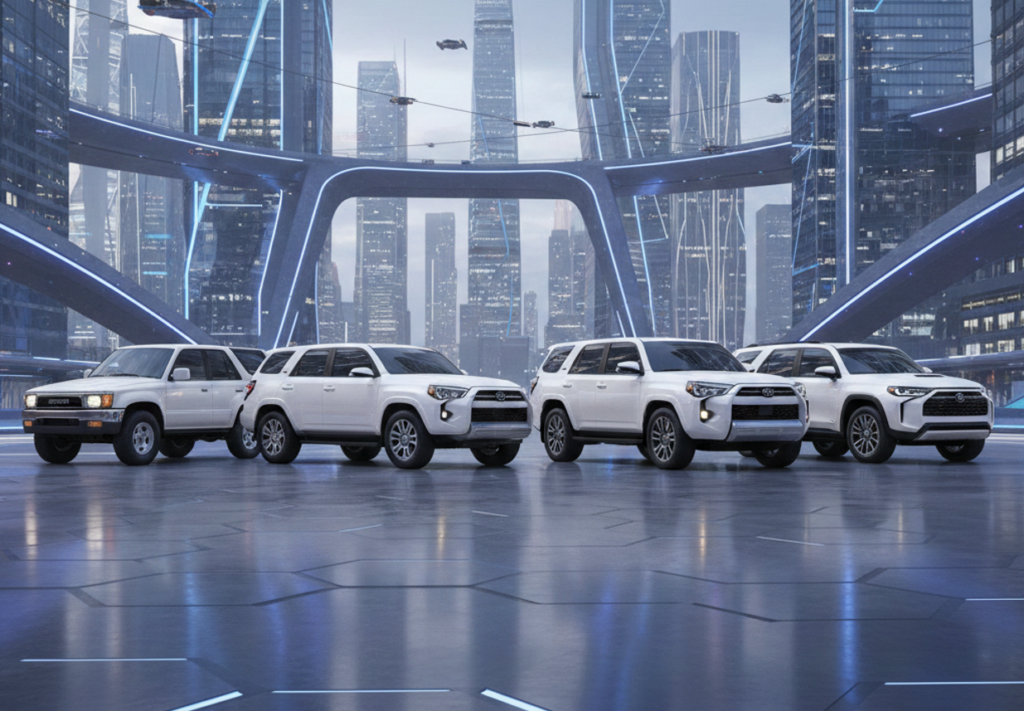
So whether you’re hunting for a vintage project, a trail toy, or a brand‑new daily driver, here’s the full breakdown of every generation, what’s great, what’s questionable, and what you should probably walk away from.
The Generations: A Timeline of Toughness
1st Gen (1984–1989): The “Trekker” Roots
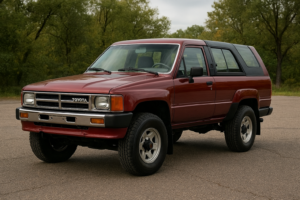 The original 4Runner was basically a Toyota Hilux pickup with a fibreglass cap slapped on the back and a couple of seats tossed in. The coolest part? The top actually
comes off. You could cruise around in a 4×4 convertible with a solid front axle (on the ’84 and ’85 models), which rock crawlers still drool over today. It was slow, loud, and leaked
whenever the clouds even thought about raining, but it had character. The kind of character modern SUVs can only dream of.
Was it fast? No. Was it quiet? Definitely not. Half the time it sounded like a toolbox rolling down a hill. And if it rained, well… you were probably getting wet. But it had this charm that’s hard to explain unless you’ve driven one. Everything was mechanical, straightforward, and a little rough around the edges in the best way.
People who own these now don’t just “have a vehicle”, they have a project, a hobby, a conversation starter. You can’t fill one up with gas without someone walking over to say, “Hey, I had one of those back in the day.” It’s that kind of truck, the one that makes strangers smile and makes you forgive all its quirks because it’s just so unapologetically old school.
2nd Gen (1990–1995): The Growing Pains
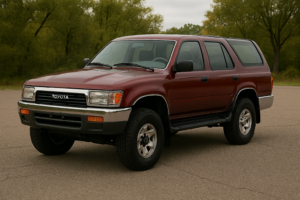 This is when Toyota tried to turn the 4Runner into a “real” SUV. Four doors, a proper body, and a more family friendly vibe. And honestly, they nailed the look, it’s peak 90s styling in the best way. Boxy, clean lines, just enough chrome to remind you what decade you’re in. But under the hood… yeah, things got a little weird.
This generation introduced the infamous 3.0L V6, lovingly (or not) nicknamed the “3‑Point‑Slow.” Anyone who’s driven one knows exactly why. It wasn’t just slow, it felt like it was constantly trying to remember what its job was. And then there’s the head gasket issue. These engines blew head gaskets so often it almost felt like a factory installed feature. If you’re looking at one today, the very first question you ask is, “Has the head gasket been done?” If the answer is no, you’re either walking away or mentally adding a couple thousand dollars to the price.
That said, there’s still something charming about the 2nd Gen. It has that old school Toyota feel, simple interior, big windows, and a driving experience that’s more “tractor” than “SUV,” but in a strangely lovable way. People who own them now usually fall into two camps: they either baby them because they’ve had them forever, or they’re planning an engine swap the moment they get it home. And honestly, with a 3.4L swap, these things become a whole different animal.
So yeah, the 2nd Gen has its flaws, but it also has a vibe. If you grew up in the 90s, you probably rode in one at some point, maybe on the way to school, maybe on a camping trip, maybe bouncing around in the back with no seat belt because it was the 90s and nobody cared. It’s a nostalgic truck, just not the most stress free one to own today.
3rd Gen (1996–2002): The G.O.A.T.
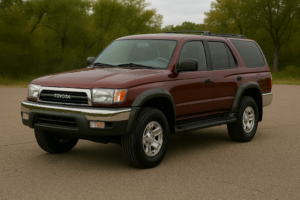 Ask any 4Runner enthusiast and they’ll tell you this is the sweet spot. Toyota ditched the pickup chassis and built a dedicated platform, and the result was honestly kind of magical. Everything just works on these trucks. The 3.4L V6 might not win any drag races, but it’s one of those engines that feels like it’ll run forever as long as you give it oil and the occasional pat on the dashboard.
The size is perfect too, small enough that you can squeeze down tight trails without sweating, but still roomy enough to load up camping gear, a dog, and a couple of friends without feeling cramped. It has that old‑school Toyota feel where everything is simple, mechanical, and built with the kind of over engineering you don’t really see anymore.
And if you stumble across one with the optional rear e‑locker, you’ve basically found a unicorn. People will literally stop you in parking lots to ask if it’s factory. Those trucks can crawl up stuff that newer SUVs with twice the tech struggle with. It’s one of those features you don’t think you need until the first time you hit a muddy hill or a rocky climb, then you’re suddenly very glad it’s there.
What makes the 3rd Gen special, though, is how it balances everything. It’s tough without being crude, capable without being complicated, and old enough to have character without feeling like a project car. A clean one is getting harder to find these days, and the people who own them tend to hang onto them like family heirlooms. And honestly, who can blame them?
Ask any 4Runner enthusiast and they’ll tell you this is the sweet spot. Toyota ditched the pickup chassis and built a dedicated platform, and the result was magic. The 3.4L V6 is arguably one of the most reliable engines Toyota has ever produced. The size is perfect, small enough for tight trails, big enough for road trips. And if you stumble across one with the optional rear e‑locker, you’ve basically found a unicorn.
4th Gen (2003–2009): The Hot Rod
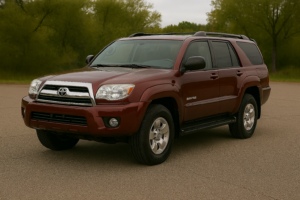 This is where things got interesting. The 4th Gen got bigger, more comfortable, and surprisingly faster. Toyota dropped the 4.7L V8 from the Land Cruiser into it, turning the 4Runner into a low‑key muscle truck. It’s one of those engines that doesn’t feel dramatic or loud — it just pulls. You tap the gas and the truck moves with this smooth, confident shove that catches people off guard, especially if they’re used to the slower V6 models.
Add in the Torsen centre differential and you’ve got a winter driving machine. These things are absolute tanks in the snow. You can be driving through a full whiteout, can’t see the end of your hood, and the truck still feels planted. It’s the kind of setup that makes you a little too brave on icy roads because it never feels like it’s struggling.
But of course, it’s not all perfect. The styling leaned a little “melted jellybean,” depending on who you ask. Some people love the rounded look, others pretend they don’t notice it. And then there’s the rust, the Achilles heel of the early 4th Gens. I learned that one the hard way with my own 2004 V8. The engine still felt like it had another lifetime left in it, but after 21 Canadian winters, the frame was basically dissolving underneath me. You don’t forget the moment you poke a spot on the frame and it crumbles like stale pastry. It’s one thing to hear about rusty 4th Gens online, it’s another to be lying on your driveway holding a handful of your truck’s skeleton.
Letting that V8 go was brutal, because when these trucks are clean, especially the V8 models, they’re honestly some of the most underrated 4Runners ever made. They’re comfortable, powerful, shockingly good in bad weather, and still totally capable off‑road. It’s the kind of rig you buy thinking it’ll just be a solid daily driver, and then a year later you’re telling everyone it’s the best vehicle you’ve ever owned. I still miss that V8 rumble, but after watching my frame turn into rust confetti, moving to a 5th Gen was the only choice that made sense, and the peace of mind has been worth it.
5th Gen (2010–2024): The Old Guard
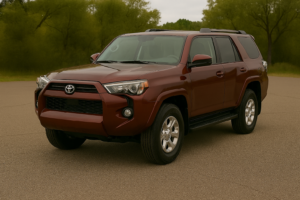 For 14 years, Toyota basically said, “If it ain’t broke, don’t fix it.” While every other SUV was busy chasing turbos, hybrids, 10‑speed transmissions, and enough screens to light up a small city, the 5th Gen just…stayed the same. Same 5‑speed transmission, same old-school V6 that drinks like it’s always thirsty, same everything. And Toyota did it on purpose. Why? Because it just works. It’s the automotive equivalent of that friend who shows up late, but always shows up.
It became the poster child for overlanding for a reason. You can roll into some tiny town in the middle of nowhere, walk into the local parts store, and there’s a good chance they’ll have whatever you need sitting on a dusty shelf. Nothing fancy, nothing complicated, just simple, rugged, stubborn reliability. It’s the kind of truck that doesn’t care if you’re commuting, camping, or accidentally taking a wrong turn onto a logging road. It just shrugs and keeps going.
And yeah…I picked one up. After dealing with the heartbreak of watching my 4th Gen V8 slowly rust itself into retirement, the 5th Gen felt like the safe choice, the “I’m tired of surprises” choice. Do I miss the V8 rumble? Absolutely. But there’s something incredibly comforting about turning the key (yes, a real key) and knowing it’s going to fire up every single time without drama. It may not be the fastest or the flashiest, but it’s the one I trust to get me home no matter what.
6th Gen (2025+): The Future is Here
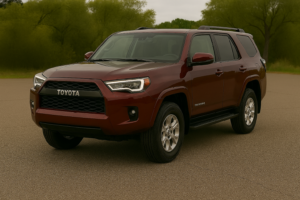 After a decade and a half, the 5th Gen is finally stepping aside. The 2025 4Runner is a whole new animal. And honestly, it feels weird even calling it a “4Runner” because so much has changed. Toyota ditched the old-school V6 and went all‑in on the 2.4L Turbo, and there’s even a hybrid version that basically turns the thing into a torque monster. It’s wild to think about, but the new truck actually makes more torque than the old V8. If you told me that ten years ago, I would’ve laughed.
And the tech…yeah, this thing is loaded. Big screens, modern safety features, cameras everywhere, proper LED lighting, and finally, finally a real interior that doesn’t feel like it was designed in 2009. You get stuff like a full digital gauge cluster, a massive infotainment screen, wireless CarPlay, and all the little conveniences the 5th Gen stubbornly refused to adopt. Even the seats look like they were designed by someone who’s sat in a car built this decade.
Off‑road gear got a serious upgrade too. There’s a new Trail hunter trim with factory armour, ARB parts, a snorkel, and suspension that looks ready for Baja straight out of the box. The TRD Pro got beefier shocks, more travel, and a stance that makes the old one look like it skipped leg day. And the whole truck sits on the TNGA‑F platform now, the same bones as the new Tacoma, Tundra, and Land Cruiser, so it’s stiffer, stronger, and way more modern underneath.
Long‑term reliability is still a giant question mark, of course. Turbos and hybrids aren’t exactly “classic Toyota simplicity,” and nobody knows yet how these new drive trains will hold up after 300,000 km. But on paper? It’s a beast. It’s like Toyota finally said, “Okay fine, we’ll join the future…but we’re doing it our way.”
And honestly? I’m in love with the look. It’s boxy, aggressive, and has that mini‑Land Cruiser vibe that just works. It looks tough without trying too hard, like the 4Runner finally hit the gym and actually stuck with it this time.
The Rankings: The Best to the Worst
1. The Best: 2017–2021 (5th Generation)
The Verdict: If you want a truck you can trust with your life, this is it. By 2017, Toyota had ironed out every quirk. It’s the “Goldilocks” era, rugged enough for adventure, modern enough for daily life, and reliable enough to make mechanics bored. The resale value is insane for a reason.
2. The Runner-Up: 1999–2000 (3rd Generation)
The Verdict: This one’s for the purists. In ’99, Toyota added the “tall coil” suspension, giving it the best factory ground clearance of the generation. It feels mechanical, connected, and honest. It’s a 500,000 kms truck that still turns heads at trail heads.
3. The Wildcard: 2006–2009 (Late 4th Generation)
The Verdict: If you can find a late model V8 that hasn’t spent its life dissolving in road salt, buy it. It’s the smoothest, most refined 4Runner ever made. It tows like a champ and still holds its own off‑road.
4. The “Proceed with Caution”: 1990–1995 (2nd Generation)
The Verdict: The looks are iconic, but the 3.0L V6 is…not. Unless you’re planning an engine swap (the 3.4L swap is common), these can drain your wallet fast. They’re also painfully slow, minivans will pass you uphill without even trying.
5. The Worst: 2003–2005 (Early 4th Generation)
The Verdict: It hurts to call any 4Runner “the worst,” but the early 4th Gens had a rough start. Cracking dashboards, V6 head gasket issues, and frames that rusted like they were allergic to oxygen. If the frame hasn’t been replaced or treated, it’s a risky buy. Yeah,…like mine.
Final Thoughts: Is the 4Runner Right for You?
At the end of the day, the 4Runner isn’t just a vehicle, it’s a lifestyle. You’re trading fuel economy and cushy ride quality for a truck that might outlast your mortgage. My journey from that 2004 V8 to my current 5th Gen taught me something important: these rigs have personalities. The V8 had soul and muscle, but it demanded attention. My 5th Gen might feel a bit more utilitarian on the highway, but there’s something comforting about knowing it’ll fire up every single time for the next couple of decades.
If you’re shopping for one, don’t let the high prices scare you off, but do your homework. Crawl underneath with a flashlight. Check the frame. Ask for service records. Whether you’re chasing the open‑air charm of a 1st Gen or the bulletproof simplicity of a 5th Gen, you’re not just buying a truck, you’re joining a community. A community that waves at each other on the trails and proudly posts odometer photos when they hit 500,000 kms.
The 4Runner has survived four decades by sticking to its roots. Even as the 6th Gen brings turbos, screens, and modern tech, the core mission stays the same: go anywhere, do anything, and get home safely. I’ll always miss that V8 rumble, but when I look at my 5th Gen sitting in the driveway, I know I made the right call for the long haul.
What about you? What generation are you driving, and how’s your experience been?